
MATHEMATICS
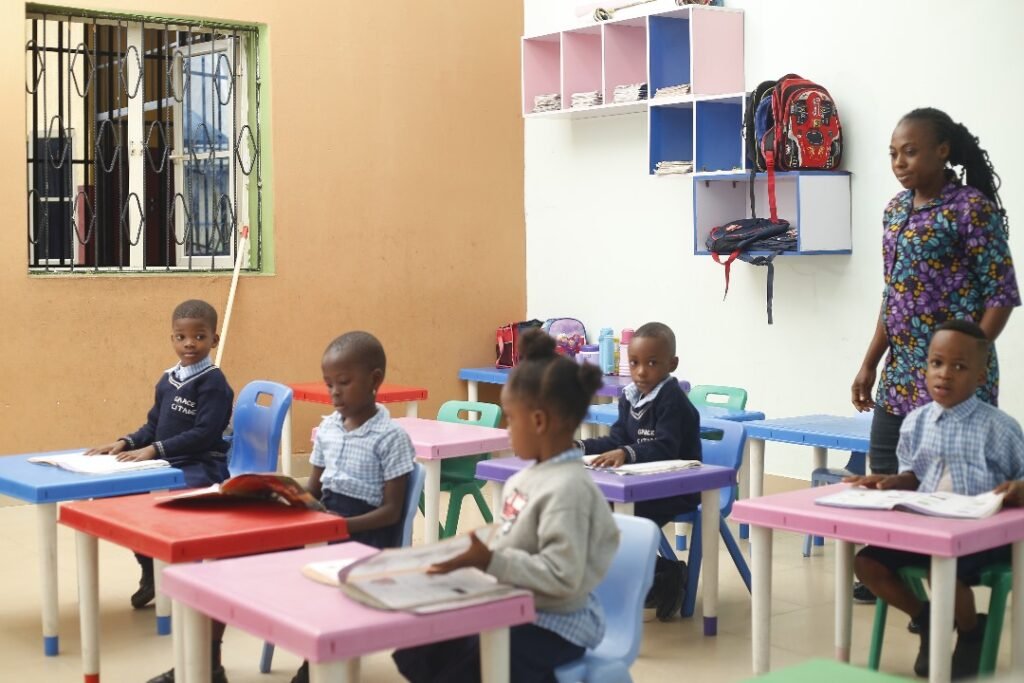
Pupils are provided meaningful, authentic mathematical work. They begin with patterns and manipulatives in preschool and transition to number sense and increasingly complex operations in the early grades. Nursery School utilizes Contexts for Learning Mathematics curriculum; Post-Nursery School uses Illustrative Mathematics by Open Up Resources. By middle school, pupils explore algebra, geometry, and data analysis. The program aligns with the Common Core standards for mathematics, and incorporates algebraic thinking in the youngest grades. Pupils develop a strong identity as mathematicians as they collaborate, thoughtfully evaluate their work, and see mistakes as opportunities for growth. They take risks and are willing to confront the unknown, learning multiple approaches when solving problems.
PRENURSERY SCHOOL
Mathematics or Numeracy focuses on foundational concepts through hands-on experiences and play. Pupils engage with patterns, identifying and creating them using various materials. They explore early number sense through the use of Montessori manipulatives, developing a tactile understanding of quantity and relationships. Activities are designed to foster curiosity and exploration, allowing children to naturally discover mathematical ideas in their environment. Teachers introduce basic vocabulary and encourage children to describe their observations and discoveries, laying the groundwork for future mathematical language and thinking.
KINDERGARTEN
Kindergarteners build a positive relationship with math. Children explore concepts using the math rack and a variety of hands-on, real-world experiences. They count collections of classroom items, identify 3D shapes in their environment, and discover patterns in everyday life. Kindergarteners build foundational skills in addition and subtraction through engaging activities with classroom manipulatives. Math is woven into daily routines—counting how many friends are in class, tracking the days left in the month, or mapping out the classroom on paper. In a beloved tradition, pairs of students read a recipe, measure ingredients, and bake “hurry-up-cake” in the classroom.
1ST GRADE
Pupils develop strong conceptual understanding, problem-solving strategies, and a positive growth mindset through authentic, engaging problems. Instruction occurs in a workshop format using whole and small groups. Pupils focus on the mathematical models of the math rack, ten frames, and the open number line. Emphasis is placed on developing automaticity and meaningful understanding, not memorization. The curriculum covers operations to 120, place value, measurement, money, and geometry. Pupils explore the context of passengers boarding, disembarking, and moving between decks of a double decker bus, with 10 seats on each deck, building automaticity with addition facts within 20.
2ND GRADE
Pupils grow as confident, flexible thinkers by deepening their understanding of numbers and strengthening problem solving skills. They solve addition and subtraction problems up to 1000 and build fluency within 100. Through hands-on exploration of equal groups, they begin to develop early multiplication strategies. A strong focus on place value helps them add and subtract three-digit numbers with accuracy and understanding. Pupils also practice coin recognition and apply their skills to real life money situations. They are encouraged to explain their thinking, explore multiple strategies, and approach challenges with curiosity and perseverance.
3RD GRADE
Pupils balance big ideas with fluency practice within contextual projects. They utilize place value understanding and properties of operations; multiply and divide with a variety of strategies and models; explore fractions as numbers on a number line, equivalencies, and comparisons; and learn shapes. They develop measurement skills through problems related to various units and estimation of time intervals. Data analysis includes representing and interpreting data using bar graphs and line plots to identify clusters, mode, and outliers of a data set. Students analyze data to estimate a shark’s location based on tourists’ reports to the nearest quarter of a meter.
4TH GRADE
Pupils use all four operations to solve problems, fluently adding and subtracting multi-digit numbers, understanding factors and multiples, and working with place value for multi-digit whole numbers. Pupils learn decimal notation for fractions and solve problems related to measurement. In geometry, they draw, identify, and measure lines and angles, and they classify shapes by their properties. Pupils learn to represent and interpret data by translating frequency graphs into value bar graphs, making inferences, and depicting co-variation. Pupils develop a deeper understanding of mathematical concepts and their applications in various contexts.
5TH GRADE
Pupils write and interpret numerical expressions, multiply multi-digit whole numbers, and perform operations with decimals and fractions. They add and subtract fractions with like and unlike denominators, and use equivalent fractions as a strategy for adding, subtracting, multiplying, and dividing fractions. Geometry and measurement involve classifying two-dimensional figures based on their properties and calculating volume and surface area of geometric solids. Data analysis includes graphing points on the coordinate plane to solve real-world and mathematical problems. Pupils continue to build on their mathematical foundation, preparing them for more advanced concepts in middle school.
6TH GRADE
Math provides students with a strong foundation in key mathematical concepts while fostering collaboration, perseverance, and a growth mindset. The curriculum emphasizes conceptual understanding, procedural fluency, and real-world application. Major topics include geometry (area, surface area, and volume), ratios and rates, fraction and decimal operations, expressions and equations, signed numbers, and data and probability. Pupils use visual models to make sense of problems and explain their thinking. Meaningful class discussions support deeper understanding and encourage pupils to learn from one another. Pupils design a garden by calculating area, applying fraction division, and determining soil volume.
7TH GRADE
With a focus on reasoning, problem solving, and algebraic thinking, students explore proportional relationships, percent increase and decrease, and linear equations using visual models, graphs, and real-world contexts. Geometry units cover circles, angle relationships, transformations, similarity, and volume of solids. Algebraic reasoning is developed through work with expressions, equations, inequalities, and systems of equations. Students engage in meaningful discussions and collaborative problem-solving that strengthen mathematical habits of mind. Interested students may participate in Mathletes, an enrichment seminar that nurtures creativity, perseverance, and strategic thinking through non-routine problem-solving skills through national AMC 8 contests and mock competitions.
8TH GRADE
Pupils learn algebraic concepts such as polynomials and factoring through tools like Lab Gears; they study functions and representations of functions, focusing on linear, exponential, and quadratic growth, with hands-on activities using a graphing calculator. Through geometry, they explore square roots and the Pythagorean theorem. Pupils learn laws of exponents and exponential equations. Pupils also gain proficiency in modeling data with linear equations, culminating in a deeper exploration of linear regression. Pupils may opt into a weekly Algebra Seminar, the equivalent of high school Algebra 1, with topics such as radical functions, rational expressions, rational exponents, and exponential regression.