
PRE-NURSERY SCHOOL
Pre-Nursery school is an exciting time of growth and development for your child as it lays the foundation for lifelong learning. We are excited to partner with you on this important first step in their educational journey.
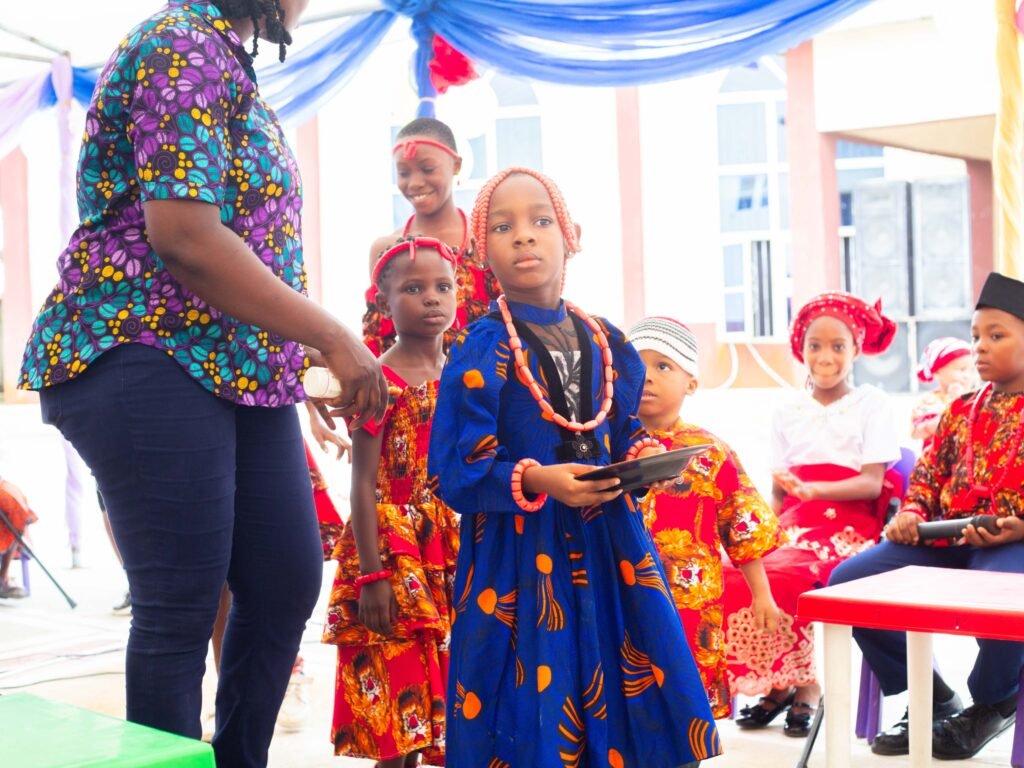
…Learning happens through joyful exploration, creativity, and hands-on discovery.
At Grace Citadel School’s child-centered pre-Nursery school, learning happens through joyful exploration, creativity, and hands-on discovery. Our experienced teachers thoughtfully guide activities that support each child’s growth, building essential social, emotional, and cognitive skills while fostering independence, responsibility, and compassion. We blend traditional Montessori materials and approaches with the best of other early childhood approaches, such as play-based, inquiry-based, and Reggio-Emilia. All are philosophies grounded in the belief of children’s abilities and utilization of their natural curiosity.
The GCS Pre-Nursey school is divided into three-and four-year-old classrooms, each with 10-12 pupils and a team of 3-4 teachers and assistants per classroom. The two classrooms share an expansive outdoor space with play structures, sandbox, climbing wall, tricycles, plants, flowers, and avocado tree! We’re proud to offer a joyful and supportive space where your child can thrive—and where families feel at home.
Practical Life
Practical Life activities teach children how to respect themselves, each other, and their environment.
These experiences help children develop a variety of skills as well as a sense of ownership in their small community. Preschoolers learn to push in their chairs, set their tables for lunch, and clean their tables after eating. These activities meet a child’s desire to feel competent, to be independent, and to belong.
Practical Life activities also help children develop a sense of order and sequence, increase coordination and concentration, and enable children to do meaningful things during their time at school.
Care of the Person
Routines such as hand washing, dressing, taking shoes off/on, sneezing safety, toileting, and cutting fruit and vegetables for snack encourage independence.
Care of the Environment
Activities such as cleaning up the classroom, sweeping, watering plants, composting, and recycling promote the beginnings of community awareness and an ecological ethic.
Social Relations
Developing skills in greeting visitors, using grace and courtesy, participating in a conversation, self-assertion, resolving conflicts, and initiating and maintaining friendships paves the way for healthy relationships.
Coordination of Movement
Exercises that strengthen fine and gross motor functioning and involve hand/eye coordination are the building blocks to future learning. Pre-Nursery schoolers work on balance, body awareness, physical coordination, carrying objects, and expressing themselves through movement.
Outdoor Plays
Play is a pre-Nursery school pupil’s work. As the focus of early children’s education, imaginative, creative play is critical for behavioral development, social emotional skills, and learning.
Through child-led peer interactions within a supportive environment, our youngest students begin to understand how social relationships work and how to interpret and express emotions through play. They process lessons, problem solve, work through conflicts, and develop independence as they explore and discover their world; at the same time, they develop imagination, creativity, self-esteem, self-regulation, and agency.
Engaging in outdoor play provides a deeper connection to science and the environment at a young age as well as an appreciation for nature. They have sensory experiences that are critical in learning how to process such stimulation, and it provides space and opportunity for inventive games, collaboration, pretend activities, and movement critical to a young child’s development of gross motor skills, physical health, and overall well being.
Socioemotional Learning
Our socioemotional learning (SL) curriculum begins with our youngest pupils as it provides a critical foundation for their growth and future academic success. Pupils are encouraged to learn to recognize, name, and understand their emotions; and modify their behaviors in support of a strong community.
Pre-Nursery schoolers gain self-awareness through identity exploration where they discover, share and celebrate things that are important to them, their families and their cultures. They also gain social awareness through experiencing diversity at an early age. They develop relationships with their teachers, acknowledging differences and learning inclusiveness.
Pre-Nursery schoolers use clear definitions of red, yellow and green zones to recognize their emotions and are given concrete tools to practice self-regulation. They learn how to communicate respectfully, set boundaries and use the peace process to resolve conflicts. While teachers help facilitate relationship-building early on, students quickly learn how to master the techniques independently.
Pupils celebrate responsible decision-making and acts of kindness in many ways, including nominating friends for the kindness chain, a string of paper links that grows as pre-Nursery schoolers celebrate kind choices throughout the school year.
Our Schedule Lite
| 8:00-8:45am Morning Extended Care | Children arrive and dive into play, books, art, and fun teacher-guided activities. |
| 8:45-9:00am Regular Preschool Drop-Off |
Pupils are dropped off in the white zone outside of school where they are greeted by teachers and staff, and walked into their classrooms. |
| 9:00-10:00am Morning Circle & Activity Time | The morning period includes a community meeting with songs, the daily schedule, stories, and a presentation of a curricular activity. Pupils engage in self- or teacher-selected activities including Montessori materials, reading from a large selection of books, beginning sound or math activities, painting, or science activities while teachers work with individual children and small groups. Children are also given time to creatively and imaginatively explore their choice of classroom toys and activities or outside activities. |
| 9:30-10:00am Morning Work | Students engage with self-selected or teacher-selected activities, including rug toys, Montessori curriculum materials, books, beginning sound or math concept games, painting, or science activities. Teachers circulate through the classroom to work with individual children and small groups. |
| 10:00-10:25am Snack Time |
After washing their hands and using the bathroom, children eat a healthy snack. Afterward, all pupils set their own tables for lunch, one of many sequential activities that allow children to develop concentration, coordination, memory, and grace in the Montessori curriculum. |
| 10:25am-12:00 pm Play and Specialist Class |
Children choose from a wide array of independent or teacher-led activities either in the classroom or the North Yard—art projects, gross-motor activities, the sandbox, building with crates and boards, basketball, trikes, swings, or the climbing wall. Our specialist teachers also lead classes in Music, Spanish, and Health & Wellness during this time. |
| 11:00am-12:00pm Circle and Free Choice |
Pupils choose to work or play independently or with a group of their peers. Pupils might create an arts and crafts project, build block structures, read or listen to stories in the reading nook, work on a practical life activity at their table, spend time in the dramatic play area, put puzzles together, or play a game with a friend. |
| 12:00-12:30 pm Lunch |
Pupils wait patiently for lunch at their tables. While the meal is being served, one of the teachers leads a language or math game, shares a new song, or presents a lesson in social-emotional skills. During lunch, children listen to a story. When they have finished eating, cleared their own dishes, and cleaned up, children may read or go outside. |
| 12:30-2:15pm | Afternoon period. |
Preschool 3: Preschool 4:
| 12:30-12:50pm Afternoon Circle |
Children learn and practice social-emotional skills (e.g., how to ask to play, how to use kind words, how to say “Stop!”, how to ask for personal space, etc.). |
| 12:50-2:15pm Naptime |
All children in Preschool 3 take naps or rest at this time, supervised by a teacher from their class. |
| 12:30-1:00pm | Yard Time. |
| 1:00-1:30pm | Afternoon Circle. |
| 1:30-2:15pm | Specialist Class. |
|
2:15-3:00pm Snack, Singing Time, Free Choice, and Closing Time |
There are afternoon snacks and activities for individuals and groups, both indoors and outdoors. At the end of the school day, children clean up the classroom together, gather their personal belongings, share reflections and gratitudes, and sing our Good-bye Song. |
| 3:00-3:15pm Dismissal | If children are headed home, they listen to stories outside while waiting to be picked up. If they are staying for Extended Day, children have a snack and story with teachers in the classrooms before heading outside to play. |
| 3:15-6:00pm Extended Day | Children are nurtured in the Extended Day program with a familiar group of teachers in activities including yard play, art projects, or other indoor activities. Additional enrichment classes are offered. |
Explore our reserves
Pre-Nursery
We invite you to learn more about our preschool program below. You can also explore our Curriculum Snapshot to see how skills learned in pre-Nursery school provide the foundation for a thoughtfully-crafted, cohesive pre-Nursery school-8th grade learning arc.


